
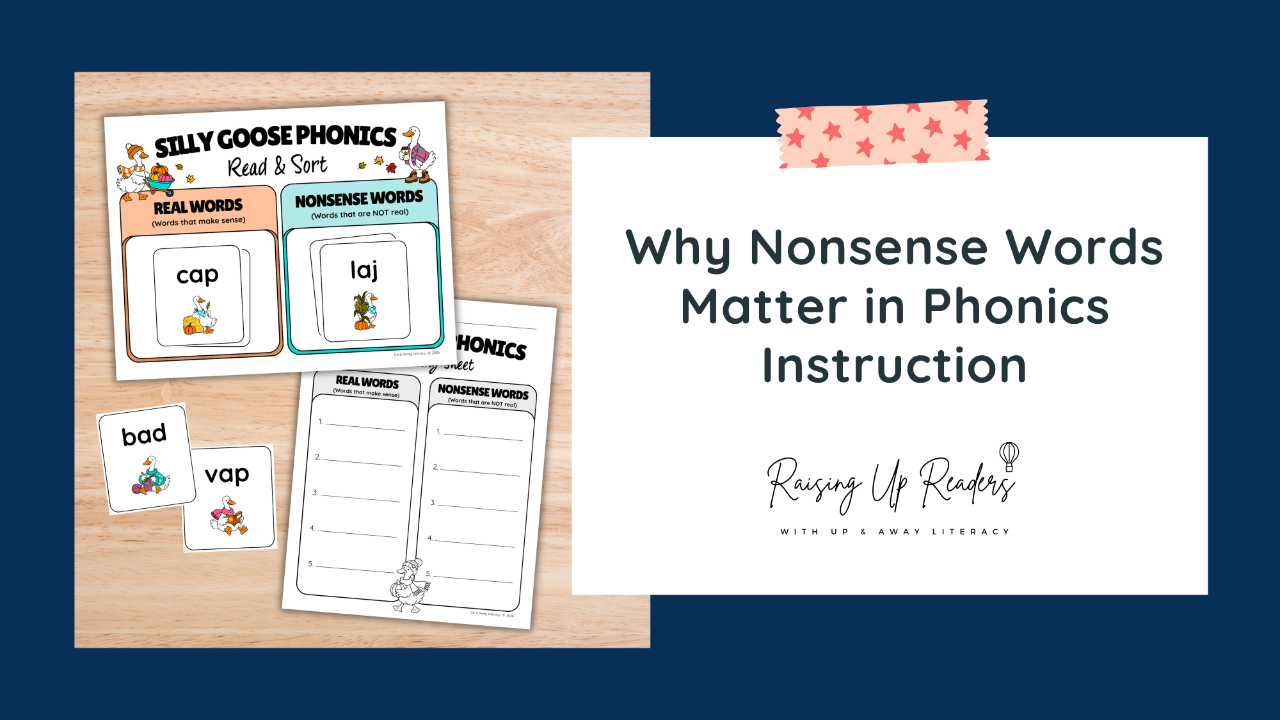
Why Nonsense Words Matter in Phonics Instruction
You hold up a word card.
shig
Immediately, a student looks at you and says:
"That's not a word!"
And they're absolutely right.
So...why are we asking students to read it?
Nonsense words can sometimes feel a little strange in a literacy lesson. After all, our goal is to teach students to read real words, sentences, and connected text—not become experts at reading made-up words.
But when they're used intentionally and in moderation, nonsense words can give us something really valuable: a chance to see whether students can apply their phonics knowledge to a word they've never seen before.
And that's exactly what makes them useful.
Why Use Nonsense Words During Phonics Practice?
Imagine you're teaching the digraph SH.
You show a student the word:
ship
The student reads it immediately.
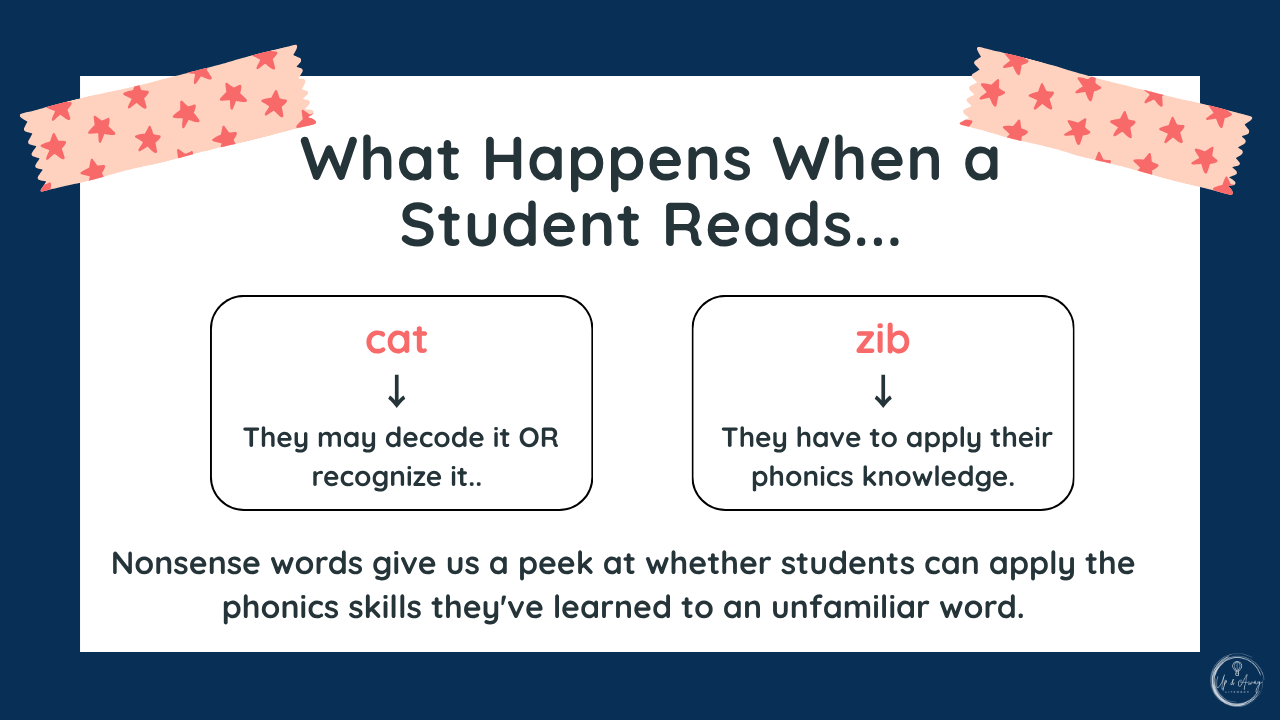
Great! But there's something we don't necessarily know. Did the student look at the letters, connect the graphemes to their sounds, and blend the word? Or have they simply seen ship enough times that they recognize it automatically?
Now show the student:
shig
They've probably never seen that letter sequence before. They can't rely on having the word stored in memory.
Instead, they have to apply what they know:
sh → /sh/
i → /ĭ/
g → /g/
Then blend those sounds together:
shig
That's what makes nonsense words useful. They can give us a clearer look at whether a student is able to transfer a phonics skill to an unfamiliar word.
What Does the Research Say About Nonsense Words?
Nonsense words—sometimes called pseudowords—have long been used as one way to examine phonics and decoding skills.
The National Reading Panel's guidance for teachers explains that phonics instruction should give students opportunities to apply their knowledge to words they do not already know. Its discussion of nonsense words notes that programs incorporating nonsense syllables have been found to be as effective as programs that do not use them. Importantly, the guidance also recommends minimizing their use and making it clear to students that the words are not real.
More recent guidance from the Institute of Education Sciences explains one of the advantages of using nonsense words for decoding assessment very simply:
“The student cannot guess the word.”
Because the word is unfamiliar, the student has to use knowledge of letter-sound relationships to decode it rather than relying on the word's meaning or previous familiarity.
Research examining pseudoword reading makes a similar distinction: unfamiliar pseudowords require readers to use spelling-to-sound correspondences because the words haven't already been encountered and stored as familiar words.
The important part? Nonsense words are a tool—not the goal.
We don't need students spending an entire phonics lesson reading lists of made-up words.
Real-word reading and meaningful connected text should remain central to instruction. Nonsense words can simply be sprinkled into practice or assessment when we want students to demonstrate that they can apply a phonics pattern to something unfamiliar.
Why I Like Sorting Real AND Nonsense Words
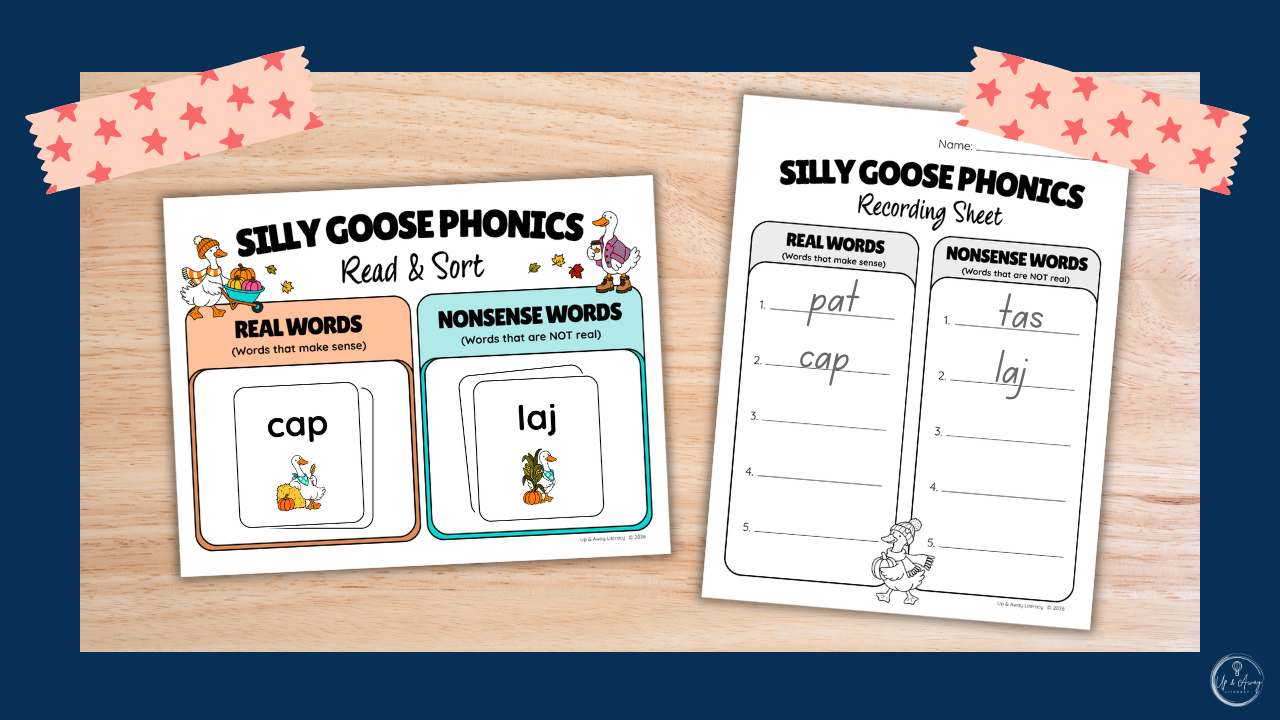
Rather than giving students a page filled entirely with nonsense words, I like mixing real and nonsense words together.
That's where a real vs. nonsense word sort comes in.
Let's go back to our SH example.
Students might read:
ship
shig
fish
shup
shop
fosh
For every word, students have to do more than glance at the beginning and guess.
First, they have to decode the entire word.
Then they have to ask: Is this a real word that has meaning—or is it a nonsense word?
So ship goes in the REAL WORDS category, while shig goes in NONSENSE WORDS.
The phonics pattern stays the same, but students have to apply it across both familiar and unfamiliar words.
Real vs. Nonsense Sorting Adds Another Layer of Thinking
There's another reason I like this type of activity: students aren't finished once they've blended the sounds.
They also have to think about meaning.
Suppose a student reads:
chat
You might ask, "Is chat a real word? What does it mean? Can you use it in a sentence?"
Then the student reads:
chab
"Did you decode it correctly? Yes! Is chab a real word? Nope!"
That distinction is important for young readers.
Students need to understand that a word can be decoded correctly even if it doesn't have meaning. If they've never worked with nonsense words before, they may assume an unfamiliar word means they've made a mistake.
That's why I always recommend explicitly telling students when nonsense words are part of an activity and explaining why you're asking them to read them.
You might simply say:
"Some of these are real words and some are silly, made-up words. Your job is to use what you know about our phonics skill to read every word. Then you'll decide where it belongs."
Now there's a purpose behind the nonsense words.
Try This: Read It. Sort It. Write It.
This can become an incredibly simple literacy center because students follow the same three steps for every word.
1. READ IT.
Students pick up a card and decode the entire word.
2. SORT IT.
They decide whether the word is real or nonsense and place the card on the correct side of the sorting mat.
3. WRITE IT.
Once all of the cards have been sorted, students record the real and nonsense words in the corresponding columns on their recording sheet.
That last step gives students another opportunity to attend to the letters and spelling pattern in each word.
And because the routine stays the same, you can use the activity again and again as the phonics skill changes.
Make Nonsense Word Practice a Little More Fun 🪿
Let's face it.
A worksheet filled with shig, fosh, and chab isn't exactly screaming BEST LITERACY CENTER EVER.
So I decided to make the nonsense part of nonsense words a little more...silly.
Enter Silly Goose Phonics: Real & Nonsense Word Sort. 🪿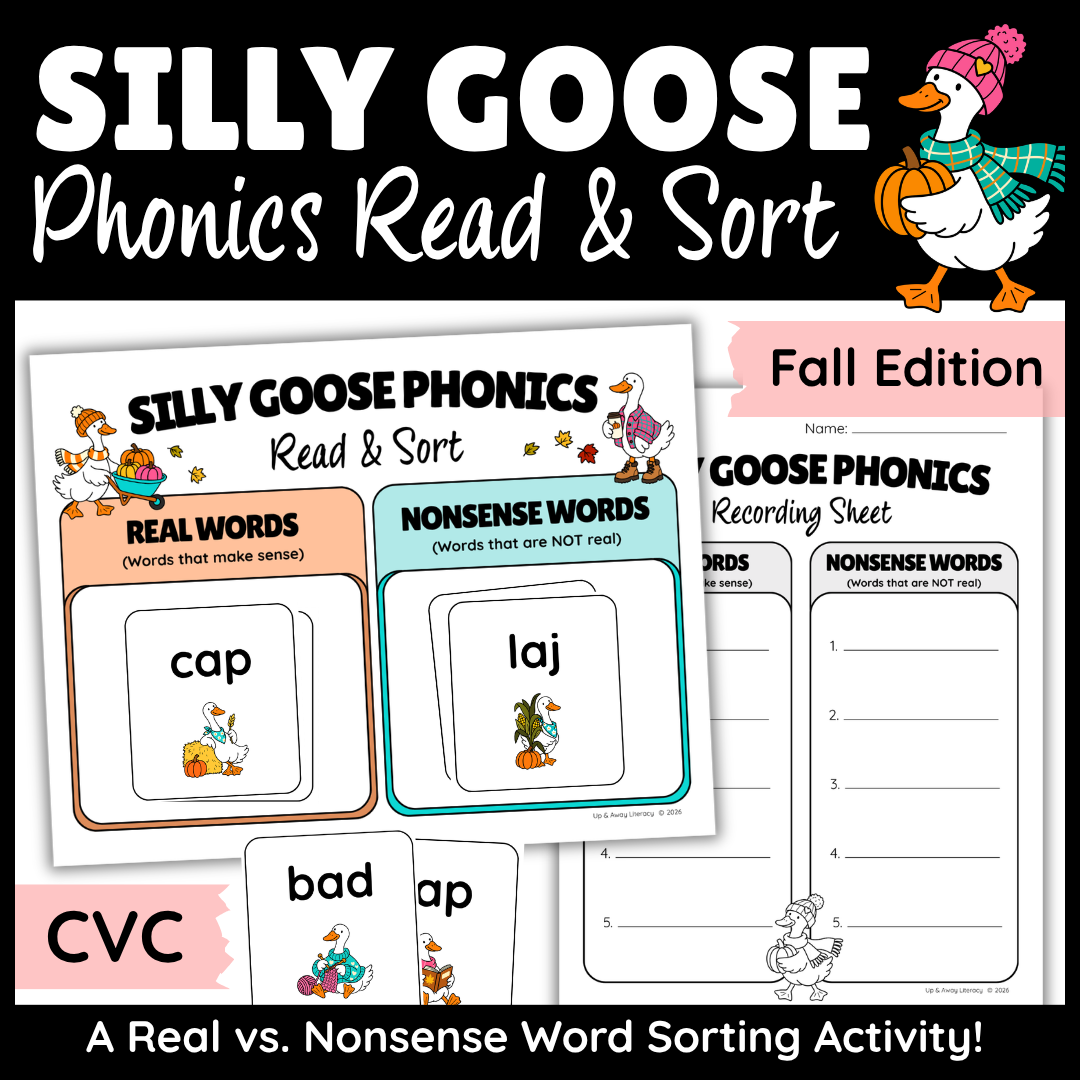
In this hands-on phonics activity, students read phonics-controlled word cards and decide whether each one is a real word or a nonsense word.
Students:
READ each word
↓
SORT it onto the Real Words or Nonsense Words mat
↓
WRITE the words on the included recording sheet
It's a simple way to add unfamiliar-word decoding practice to your literacy centers while still keeping real-word reading at the center of the activity.
Grab Silly Goose Phonics: Real & Nonsense Word Sort →
One Simple Activity, Lots of Phonics Thinking
Nonsense words don't need to take over your phonics block.
And they shouldn't.
But when they're intentionally mixed into real-word practice, they can give students another opportunity to show that they aren't simply recognizing familiar words—they can apply what they know about the alphabetic code to decode something new.
So the next time one of your students looks at shig and announces: "That's not even a word!"
You can smile and say: "You're right, silly goose. But can you read it?" 🪿
Stay in-the-know!
New tips, courses, and resources delivered straight to your inbox. Sign up for our email list below so you don't miss a thing!
