
Building Strong Readers: What to Do When a Student Struggles with Vocabulary
(Note: This is Part 7 of an 8-week blog series called Building Strong Readers. If you haven't read the rest of the series click HERE)
Vocabulary is a component of reading instruction that often gets pushed to the side—not because it isn’t important, but because teachers already juggle so many priorities: phonics, fluency, comprehension, spelling… and the list goes on.
But here’s the truth: vocabulary plays a huge role in helping students understand what they read, make connections, and build deeper meaning from text. Without a strong vocabulary foundation, even skilled decoders can struggle to make sense of what they’re reading. In today’s post, we’re diving into why vocabulary matters so much, what the research says, and how both intentional and incidental instruction can make a big impact.
Why Vocabulary Matters
Before we get into the importance of vocabulary instruction, let's first discuss what is meant by a student's lexicon.
A student’s lexicon refers to the collection of words they understand and can use—their personal “mental dictionary.” This includes words they can read, recognize when they hear them, use in conversation, or understand in context.
As students grow as readers, their lexicon expands—not just with single words, but with shades of meaning, multiple meanings, and relationships between words. Some estimates report that kindergarteners come to school recognizing 4,000-5,000 base words and graduate high school with a lexicon of 40,000-50,000 words (Biemiller, 2005).
Research shows that vocabulary knowledge is strongly linked to reading comprehension—students with limited vocabulary often struggle to make sense of text, even if they can decode the words accurately.
By intentionally teaching vocabulary, we’re not just helping students learn new words—we’re giving them tools to make sense of increasingly complex text, build connections between ideas, and become effective communicators.
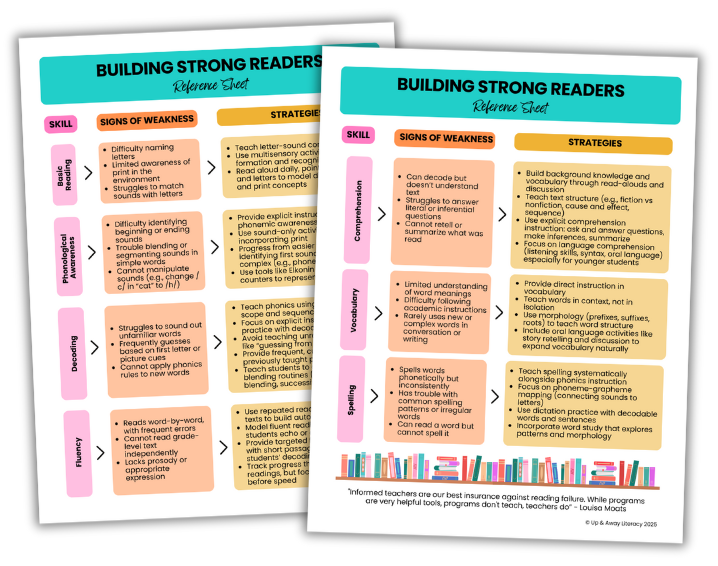
Signs a Student Struggles with Vocabulary

Watch for these signs that a student may need more vocabulary support:
- Shows limited understanding of word meanings, especially academic or subject-specific words
- Has difficulty following directions that include unfamiliar words
- Rarely uses new or complex words in conversations or writing
- Often responds with "I don't know" or uses vague language
- Struggles to infer word meanings from context
Effective Vocabulary Instruction
Among the National Reading Panel's recommendations for vocabulary instruction, there are two that we'd like to highlight in this blog post:
- Vocabulary should be directly taught.
- Vocabulary can be acquired through incidental learning.
Let's discuss the difference between direct instruction and incidental learning of vocabulary, and why both are important!
Intentional vs. Incidental Instruction
There are two types of vocabulary instruction: intentional and incidental.
- Intentional instruction happens when teachers deliberately select and teach specific words, focusing on meaning, usage, and connections to other vocabulary. This kind of instruction includes modeling word meanings, providing student-friendly definitions, exploring morphology, and offering repeated practice in meaningful contexts.
- Incidental instruction occurs naturally through reading, conversation, and exposure to language. Students may learn new words by hearing them in a story, talking with peers, or encountering them in content areas.

Both types of instruction play an important role: intentional teaching gives students direct access to high-impact words they may not learn on their own, while incidental learning allows vocabulary to grow organically through rich language experiences. When combined, they create a powerful, well-rounded approach to building language and comprehension.
Intentional Instruction Ideas
Here are some specific, practical ideas for intentional vocabulary instruction:
⭐ "Word of the Day" Routine
Create a “Word of the Day” (or week) routine where students explore the meaning(s) of one high-impact word at a time. Tier 2 words are recommended for this type of word study. Here's the definition of these kinds of words:
Tier 2 words are high-utility vocabulary words that appear frequently across a variety of texts, subjects, and contexts. These words are more precise and sophisticated than everyday Tier 1 words like happy or big, but they aren’t as domain-specific or rare as Tier 3 academic terms like photosynthesis or multiplication. Examples of Tier 2 words include predict, explain, enormous, and frustrated.
⭐ Vocabulary Notebooks or Word Journals
Vocabulary notebooks are a great way for students to collect new words, explore their meanings, and review learned words periodically. This can be paired this with a "Word of the Day" routine for maximum impact.
We created a resource just for this reason! Help your students develop a natural curiosity about words with their very own Word Collector Notebook. Students will become word collectors, just like Jerome in the book, The Word Collector, by Peter H. Reynolds. The materials in this resource allow you to create a "Word of the Day" (or week) routine to help build student's vocabulary in a fun and engaging way! Click the image to learn more about what's included.

⭐ Use Student-Friendly Definitions
Use student-friendly definitions instead of dictionary language, and pair them with simple visuals, gestures, or real objects when possible.
⭐ Encourage Partner Talk or Discussion with Learned Words
Encourage repeated oral use by intentionally planning partner talk or discussion questions that require students to use newly learned words.
⭐ Teach Morphology & the Etymology of Words
Morphology = the study of the structure of words and how they are formed. It focuses on the meaningful parts of words—called morphemes—such as roots, prefixes, and suffixes.
Understanding prefixes, suffixes, and root words helps students unlock the meanings of many unfamiliar words.
-
Teach common prefixes (un-, re-, etc.) and suffixes (-ful, -less, etc.)
-
Show how root words carry core meanings that can be changed with affixes
-
Use word-building activities to practice analyzing and creating words
- To learn more about morphology, read our blog post HERE
Etymology = the study of the history, or origin, of words
Teaching the etymology of words helps students understand not just what a word means, but why it means what it does. When students learn where words come from and how they evolved, vocabulary becomes more memorable and meaningful. Etymology also helps students recognize patterns across words, especially those with Greek and Latin roots, which make up a large portion of academic language.
Looking for a fun, done-for-you resource all about the etymology of words? Just like the popular Holidays Around the World classroom experience, Words Around the World takes students on an exciting vocabulary journey — a virtual field trip — but instead of traditions, students explore loanwords: real English words that originally came from other languages around the globe. Students will be amazed to learn that words like pizza, ballet, emoji, and kindergarten didn’t start in English — but became part of it!

Your students will love “traveling” to each country, listening to music, collecting passport stamps, and discovering familiar words with fascinating histories. This project makes learning feel like a field trip — without ever having to leave your classroom! Click the image above to learn more.
⭐ Make It Fun with Games
So many games can be used as is, or slightly adapted for vocabulary instruction. Here are a few ideas:
- Pictionary- To play, write previously taught vocabulary words on slips of paper and place them in a container. Students take turns drawing a word and sketching it on the board—without writing letters or numbers—while the rest of the group or class guesses the word. Once the correct word is identified, take a moment to deepen learning: ask students to use it in a sentence, share synonyms or antonyms, identify its part of speech, or explain why the drawing represents the word.
- Headbanz- Play this game just like the original Headbanz game but instead of the included words, use index cards to write learned vocabulary words on.
- Jenga- Using label stickers with vocab words that students have learned, attach a word to each Jenga piece. Every time a piece is pulled out from the tower, the student must read the vocab word and explain the meaning of it in their own words.
Incidental Instruction Ideas
Here are some simple and effective ways to build incidental vocabulary through natural language exposure and meaningful experiences:
-
Read aloud daily, choosing rich, high-quality texts with diverse language. Pause briefly to give a quick explanation of unfamiliar words (“grumbled means said in an annoyed voice”) without turning it into a long lesson.
-
Model rich language in conversation, swapping simple words for more precise ones (e.g., “You walked fast—so you hurried” or “That dog is enormous, much bigger than just big!”).
-
Encourage student talk, especially during turn-and-talks, partner discussions, morning meetings, or inquiry activities, so they hear words used naturally in context.
-
Connect words to real-life experiences, like noticing vocabulary during science experiments, outdoor walks, or classroom routines (“The ice is melting—turning from solid to liquid.”).
-
Ask open-ended questions that naturally require students to stretch their language, such as “What makes you think that?” or “How would you describe it?”
-
Use storytelling and play, especially in younger grades—dramatic play, puppets, STEM challenges, and imaginative writing give students opportunities to hear and use new words in authentic ways.
These experiences help vocabulary grow organically—not through drills or memorization, but through meaningful exposure, curiosity, and real language use.
Recommended Reading
If you'd like to explore the topic of vocabulary further, here are a few of our favorite books:
- Bringing Words to Life: Robust Vocabulary Instruction by Isabel L. Beck, Margaret G. McKeown, and Linda Kucan
- Multisensory Teaching of Basic Language Skills by Judith R. Birsch
- For the Love of Words: Vocabulary Instruction that Works by

Building Strong Readers Reference Sheet (FREE DOWNLOAD!)
If you would like a printable version of these reading skills and strategies to apply when you spot a weakness, click the image below to download our free Building Strong Readers Reference Sheet!
The Resources You Need, All in ONE Membership!
We understand that purchasing resources one by one adds up fast—and as teachers, we know every dollar matters. That’s why our K-2 membership, Launching Literacy, is a smarter and more cost effective option. Our membership gives you everything you need for small group instruction—all in one place—so you can save time, money, and stress.
No more weekends wasted hunting for Science of Reading–aligned heart word resources, phonics lessons, and decodable texts. With Launching Literacy, you simply log in, choose the skill you want to teach, and instantly download detailed, ready-to-use lesson plans and activities.
In just a few clicks, your small group lessons are prepped and ready to teach—so you can spend less time planning and more time making an impact in your classroom. It’s planning made simple, effective, and affordable.

We hope that you found this blog post helpful! Whether you choose to join the membership or not, we are always here to help you in any way we can. Send us an email at: [email protected] with any questions you have!
Stay In-The-Know!
New tips, courses, and resources delivered straight to your inbox. Sign up for my email list below so you don't miss a thing!
