

Why Syllable Types Matter & How To Teach Them
There’s always that moment, right? A student is confidently reading CVC words… and then they hit napkin or robot and everything just stalls. That shift into multisyllabic words can feel huge, and especially for our struggling readers. Decoding is no longer about slowly sounding out one small chunk at a time. It becomes about recognizing patterns, breaking words apart strategically, and understanding how English actually works.
That’s exactly why understanding syllable types matters so much. It's part of the foundation we’re building now so that down the road students can stop guessing at big words and start approaching them with a plan. They'll notice patterns. They'll chunk words intentionally. And when texts get longer and vocabulary gets more complex down the road, they’re equipped with the tools and confidence to decode instead of shutting down.
What Are Syllable Types?
Words in our English language are made up of 6 different syllable types. The word CLOVER can help kids remember each type.

Closed Syllable
A closed syllable has a single vowel followed by one or more consonants. The consonant “closes in” the vowel and makes it say it’s short sound.
Examples: cot, ship, stand, throb
Multisyllabic words containing closed syllables: muffin (muf|fin), insect (in|sect), basketball (bas|ket|ball)

Consonant-le
A consonant-le syllable has a consonant followed by the letters le. This syllable type is always found in multisyllabic words, as the consonant-le syllable can't stand alone.
Examples: eagle (ea|gle), bible (bi|ble), fizzle (fiz|zle), incredible (in|cred|i|ble)

Open Syllable
An open syllable has a single vowel with no consonant after it. The vowel is out in the “open” (not closed in) and says it’s long sound.
Examples: hi, go, me
Multisyllabic words containing open syllables: robot (ro|bot), table (ta|ble), zero (ze|ro), volcano (vol|ca|no)

Vowel Team
A vowel team syllable has two or more letters working together to make one vowel sound. These letters are like a “team” working together.
Examples: rain, boat, stream
Multisyllabic words containing vowel team syllables: freedom (free|dom), discount (dis|count), rainbow (rain|bow)

Silent E
A Silent E syllable has a vowel, consonant, silent e pattern. The e is silent and makes the vowel say its long sound.
Examples: home, cute, whale
Multisyllabic words containing silent E syllables: cupcake (cup|cake), inside (in|side), recognize (rec|og|nize)

R-Controlled Vowel
An r-controlled vowel syllable has a vowel followed by the letter r. The r “controls” the vowel and they make a special sound together.
Examples: art, north, bird, her, burn
Multisyllabic words containing r-controlled vowel syllables: artist (ar|tist), ornament (or|na|ment), support (sup|port)
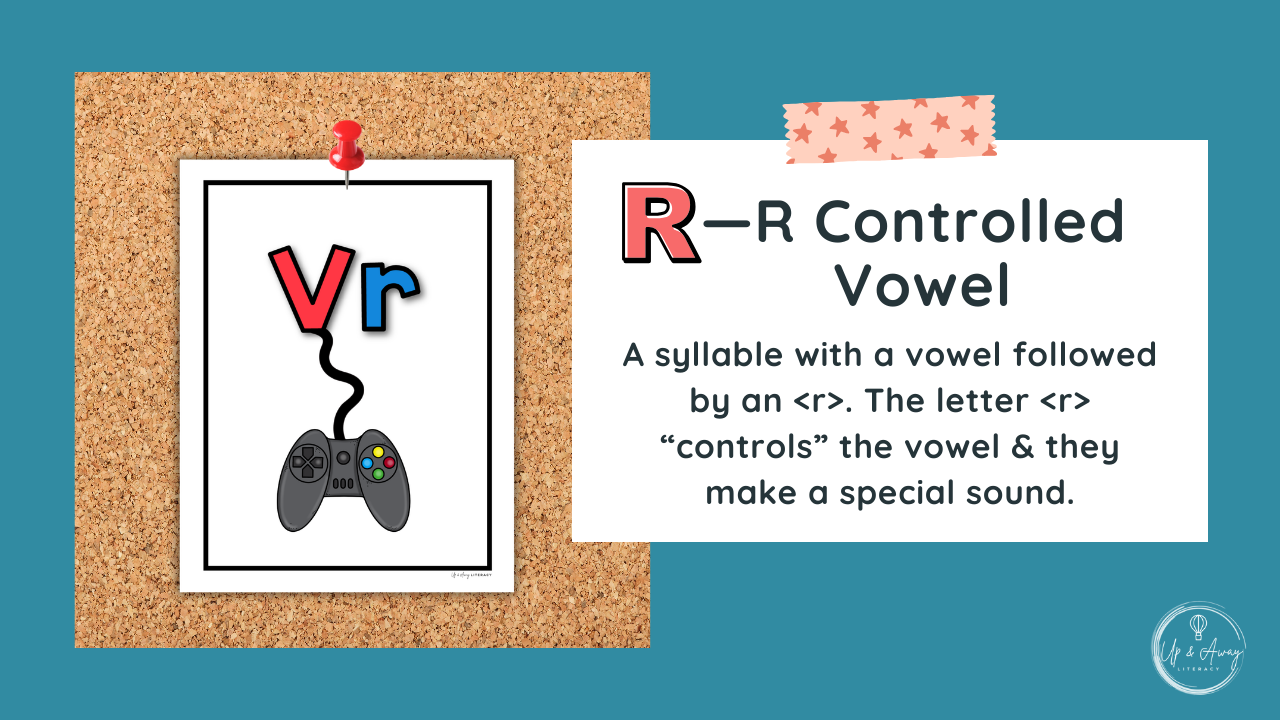
Understanding the different types of syllables is foundational to reading success. When students can recognize and apply syllable patterns, decoding and spelling multisyllabic words becomes significantly easier, and far less overwhelming.
Why Are Syllable Types So Important?
Supports Decoding of Multisyllabic Words
By second, and definitely third grade, students start to encounter more complex vocabulary. Without syllable knowledge, these words can feel overwhelming.
But with syllable awareness, students can break words into manageable parts, apply their phonics knowledge, and decode with confidence.
Reduces Cognitive Load
Reading requires working memory. If students struggle to decode every word, their brain has less energy for comprehension. Automaticity frees up mental space. When students quickly recognize syllable patterns, decoding becomes more automatic, and comprehension improves.
Improves Spelling
Spelling is the mirror image of decoding. When students understand syllable types:
- They know why rabbit has a double consonant (closed syllable pattern).
- They know why hope needs a silent e, but hop does not (VCe vs. closed syllable).
-
They know why little has a silent e (consonant-le syllable).
Syllable instruction strengthens both reading and writing.
Builds Confidence With Big Words
Students often believe longer words are “hard words.” Teaching syllable types changes that mindset. When students realize that big words are made of smaller parts they know, they gain a sense of control. Big words become solvable puzzles.
When Should We Teach Syllable Types?
There are no hard and fast rules for when to teach each syllable type. In general, instruction should begin early and build systematically across grade levels. Below are some recommendations along with the related common core standards for grades K-3.
Kindergarten: Begin with closed and open syllables as students learn short and long vowels.
Common Core Standards:
- RF.K.3- Know and apply grade-level phonics and word analysis skills in decoding words.
- RF.K.3.b- Associate the long and short sounds with the common spellings (graphemes) for the five major vowels.
1st Grade: Introduce the silent E, r-controlled vowel, consonant-le, and (basic) vowel team syllables, and begin to teach syllable division strategies
Common Core Standards:
-
RF.1.3.b- Decode regularly spelled one-syllable words.
-
RF.1.3.c- Know final -e and common vowel team conventions for representing long vowel sounds.
-
RF.1.3.e- Decode two-syllable words following basic patterns by breaking the words into syllables.
2nd Grade: Introduce more vowel teams, and continue to teach students how to apply syllable division strategies to multisyllabic words
Common Core Standards:
-
RF.2.3.b- Know spelling-sound correspondences for additional common vowel teams.
-
RF.2.3.c- Decode regularly spelled two-syllable words with long vowels.
3rd Grade: Focus on decoding multisyllabic words with all 6 syllable types. Words should contain all syllable division patterns, and have a variety of prefixes and suffixes.
Common Core Standards:
When we teach syllable types, we are not just teaching patterns, we're giving students a strategy for unlocking unfamiliar words, a tool for spelling accurately and a bridge from phonics to fluent reading.
Want a Ready-Made Teaching Resource?

6 Types of Syllables Digital Lesson + Practice Pages + Posters | CLOVER Strategy
This engaging, interactive digital lesson, practice pages, and posters help students master the 6 syllable types using the word: CLOVER.
What’s Included:
🍀Interactive Digital Lesson (Google Slides)
A Google Slides lesson teaches students to remember the 6 syllable types using the CLOVER acronym. Each syllable type is introduced with engaging illustrations and example words for each type. Then, guided practice follows where students can practice reading words and identifying the syllable type. Animations help to keep students engaged throughout!
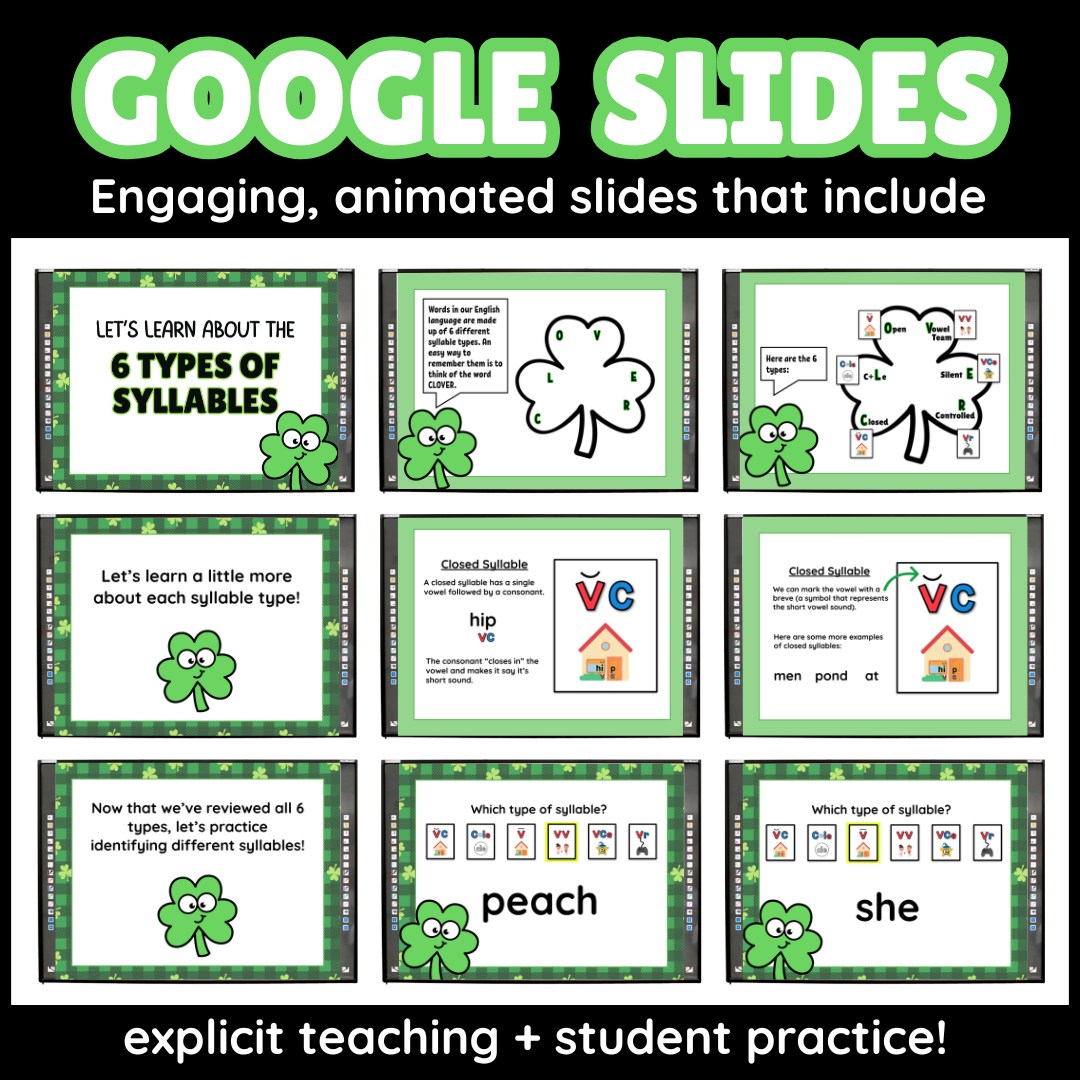
🍀Posters
Each poster contains bright, clear visuals that help students remember each syllable type. Use them for reference during reading instruction, small groups, or during intervention. These posters make the abstract concept of syllable types concrete and visual.

🍀Student Practice Pages (5 Versions)
After reviewing the 6 types of syllables, students can practice on their own, with partners, at centers, or however you see fit! They will practice reading different words and identifying the syllable type by writing it on the line. 5 different versions included.


The Resources You Need, All in ONE Membership

We understand that purchasing resources one by one adds up fast—and as teachers, we know every dollar matters. That’s why our K-2 membership, Launching Literacy, is a smarter and more cost effective option. Our membership gives you everything you need for small group instruction—all in one place—so you can save time, money, and stress.
No more weekends wasted hunting for Science of Reading–aligned heart word resources, phonics lessons, and decodable texts. With Launching Literacy, you simply log in, choose the skill you want to teach, and instantly download detailed, ready-to-use lesson plans and activities.
In just a few clicks, your small group lessons are prepped and ready to teach—so you can spend less time planning and more time making an impact in your classroom. It’s planning made simple, effective, and affordable.
We hope that you found this blog post helpful! Whether you choose to join the membership or not, we are always here to help you in any way we can. Send us an email at: [email protected] with any questions you have!
Stay In-The-Know!
New tips, courses, and resources delivered straight to your inbox. Sign up for my email list below so you don't miss a thing!
